SevenRooms vs OpenTable vs Chope vs TableCheck (2026)
SevenRooms costs about $499 a month, TableCheck about $250, OpenTable $149 to $499 plus per-cover fees. Chope takes commission. Here is who each suits.
 LucasCo-founder, Revasi
Insights12 min readPublished on April 27, 2026
If you run a premium restaurant or bar in Bali, Singapore, Bangkok or Jakarta, four platforms will land on your shortlist almost regardless of who you ask. Chope, SevenRooms, TableCheck and OpenTable are the names that come up in every operator conversation, every vendor pitch deck, and every comparison search.
The four are often discussed as if they're the same product at different price points. They aren't. Each was built for a different buyer, with a different revenue model, in a different region. The right way to evaluate them isn't to rank them. It's to figure out which pairwise comparison actually matters for your venue, and look at that one closely.
This guide breaks the four down head-to-head: what each is good at, where each falls short, and which pairs are genuinely competing for the same buyer.
Quick Verdict: Which Platform Wins by Venue Type
The honest answer is that no single platform wins across all venue types. The cleanest way to navigate the four is by venue model.
| Venue type | Best fit | Why |
|---|---|---|
| 40-seat fine-dining restaurant in Ubud | None (pick a regional independent platform) | All four over-price or mis-target this segment |
| 200-cover hotel restaurant in Singapore | TableCheck or SevenRooms | Enterprise CRM and PMS depth |
| Mid-market casual dining in Bangkok | Chope | Real consumer reach via marketplace |
| Tourist-driven steakhouse in Bali | OpenTable | Inbound US/European traveller traffic |
| 30-seat cocktail bar in Jakarta | None (pick a regional independent platform) | Small venue, premium positioning, marketplace conflict |
| Multi-property restaurant group (10+) in Asia | SevenRooms or TableCheck | Multi-property workflows |
Most premium independent venues, like the 40-cover tasting menu room or the 30-seat cocktail bar, sit in the rows where the answer is "none of the four." That gap is real and worth naming.

What Does Each Platform Actually Offer?
Chope, SevenRooms, TableCheck and OpenTable each occupy a different category. Chope is a Southeast Asia consumer marketplace with around 13,000 listed eateries at the time of its July 2024 acquisition by Grab (TechCrunch, 2024). SevenRooms and TableCheck are enterprise CRM and reservation backends. OpenTable is the global incumbent marketplace. A one-paragraph read on each, before the head-to-heads.
Chope is the largest consumer reservation marketplace in Southeast Asia, with around 13,000 listed eateries at the time of its acquisition by Grab in July 2024 (TechCrunch, 2024). Strong consumer reach in Singapore, Thailand, Indonesia, Hong Kong. Commission-based revenue model, app-driven discovery, promotional and discount pressure on the marketplace.
SevenRooms is a New York–origin reservation and CRM platform built for large US hotel groups and multi-property restaurant chains. Public starting price around $499 per venue per month (GetApp, 2025). Deep guest CRM, marketing automation, hotel PMS integrations. No marketplace.
TableCheck is a Tokyo-headquartered platform with deep coverage in Japan and a growing Asia-Pacific footprint. Public starting price around $250 per month (GetApp, 2025). Strong fit for luxury hotel F&B operations. Partnered with Chope in 2024 to combine inventory across both networks (TableCheck, 2024).
OpenTable is the global reservation incumbent: roughly 60,000 restaurants and 1.7 billion annual seated guests on its network (OpenTable, 2025). Pricing tiers at $149, $299 and $499 per month, layered with $1.00–$1.50 per-cover fees on network bookings (Tekpon, 2025). Strongest in North America; thinner in Southeast Asia.
Chope vs OpenTable: Which Marketplace Actually Drives Traffic in Asia?
Chope and OpenTable are the only two platforms in this comparison that operate as consumer marketplaces. Both ship a branded consumer app, both charge per-booking economics, and both compete for the same line item on a venue's tech budget. The deciding question is which marketplace your guests actually use.
Where Chope wins. Consumer reach in Southeast Asia. If your venue depends on guests discovering you through a phone app, particularly in Singapore, Bangkok, Bali or Jakarta, Chope's network is materially larger than OpenTable's in this region. Promotional campaigns, loyalty rewards, and the integration with Grab's broader consumer ecosystem amplify that reach.
Where OpenTable wins. Inbound traveller traffic. A restaurant in Ubud whose guest mix is 70% international (US, Australian, European) and 30% regional often gets meaningful flow from OpenTable's global app: guests who installed it for a New York trip and now use it for travel. The dining-rewards programme also drives repeat behaviour.
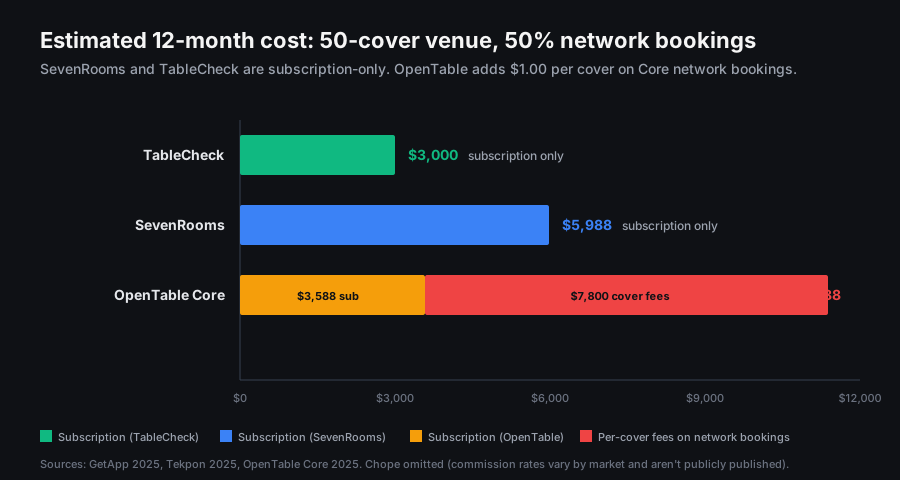
Where the math gets honest. Chope's commission model can compound into five-figure annual fees on volume. OpenTable's $1.00 per-cover fee on Core plan network bookings stacks on top of the $299 monthly subscription (Tekpon, 2025). For a 50-seat venue running 25 service nights with half its bookings through marketplace channels at OpenTable's Core rate, that's roughly $7,800 in cover fees a year before subscription. Chope's commission can land in the same range or higher depending on the market.
If the marketplace is genuinely driving incremental bookings you wouldn't otherwise get, that math works. If the marketplace is mostly capturing bookings that would have arrived directly anyway, you're paying commission on flow you don't need.
SevenRooms vs TableCheck: Two Enterprise Platforms, Different Origins
SevenRooms and TableCheck are the only two platforms in this comparison that target enterprise: hotel groups, restaurant chains, large multi-property operators. Both ship deep CRM, both integrate with hotel PMS systems, both come with enterprise pricing and onboarding. The deciding question is regional fit.
Where SevenRooms wins. Marketing automation depth and US-style operations. SevenRooms grew up serving large US hotel groups and the product still reflects that origin: sophisticated email automation, guest-segmentation tooling, multi-property loyalty mechanics, and integrations with the marketing stack a US-headquartered operator already uses.
Where TableCheck wins. Asia-Pacific operational fit. Tokyo origins, multi-language coverage, time-zone-aligned support, and a customer base of luxury hotel groups across Japan, Korea, Singapore, Hong Kong and Bali. The product reflects that customer base: deposit logic that handles regional payment methods, dining-style configurations that accommodate Japanese kaiseki and Indonesian rijsttafel, and an onboarding model calibrated for hotel F&B teams.
Where the math gets honest. Both platforms are enterprise software with enterprise pricing. SevenRooms' starting figure of about $499 per venue per month (GetApp, 2025) adds up across a hotel portfolio quickly. TableCheck's published starting figure of about $250 (GetApp, 2025) looks lighter, but enterprise quotes are typically custom and the gap narrows with scale and feature depth.
The shortest version: pick TableCheck if you're an Asia-headquartered hotel group. Pick SevenRooms if you're a US-anchored multi-property operator with strong marketing automation requirements. Ignore both if you're a single fine-dining restaurant.
Chope vs TableCheck: Both Asian, Different Segments
Chope and TableCheck are the two Asia-focused platforms on this list, and they are routinely lumped together as "the regional options." They aren't competing for the same buyer.
Where Chope wins. Direct-to-consumer marketplace. If your job is to fill seats at a casual or mid-market venue and you don't mind sharing the front-end with the platform, Chope's app puts your venue in front of guests. The pricing model, commission per booking, aligns with that volume play.
Where TableCheck wins. B2B SaaS for premium operators. TableCheck doesn't have a consumer marketplace in the Chope sense. The product is a backend reservation and guest-management system that hotel groups deploy across multiple F&B venues, with the booking flow living on the venue's own digital surface rather than on a TableCheck-branded app.
The two products partnered in 2024 specifically because their networks complement rather than overlap (TableCheck, 2024). A hotel running TableCheck can now optionally surface inventory through Chope's marketplace. The partnership is itself a signal that the two platforms see themselves as serving different layers of the stack.
The buyer test. If you can answer the question "do I want guests to find me through an app?" with a clear yes, evaluate Chope. If you can answer it with a clear no, evaluate TableCheck (or a smaller regional independent if you're under enterprise scale). If you're not sure, you're probably mid-market, and mid-market is where Chope tends to win.
What Does Each Platform Cost in 2026?
Headline subscription rates are misleading because the four platforms run on fundamentally different revenue models. SevenRooms starts at roughly $499 per venue per month (GetApp, 2025). TableCheck starts around $250 (GetApp, 2025). OpenTable runs $149 to $499 plus per-cover fees on network bookings (Tekpon, 2025). Chope is commission-based with rates that vary by market. The chart below models a single scenario; the table below is the operator-relevant version.
| Criterion | Chope | SevenRooms | TableCheck | OpenTable |
|---|---|---|---|---|
| Headline price | Commission-based | ~$499/venue/month | ~$250/month starting | $149–$499/month |
| Per-cover fees | Yes (marketplace) | No | Optional / tiered | $1.00–$1.50 on network bookings |
| Marketplace included | Yes (consumer-facing) | No | No | Yes (network) |
| Origin | Singapore | New York / US | Tokyo | San Francisco / US |
| Strongest region | SEA (Singapore, Thailand, Indonesia) | North America | Japan + Asia-Pacific | Global, strongest in NA |
| Built for | Volume-driven mid-market | US hotel groups | Asia hotel groups | Mid-market global |
| Free trial | N/A | No | Yes | No |
| Asia-time-zone support | Yes | Limited | Yes | Limited |
| Booking on your domain | No (Chope-branded) | Partial | Yes (configurable) | Limited |
A few notes on reading this. SevenRooms and TableCheck don't publish full pricing publicly, so figures reflect third-party indexes and vendor demos — your quote will vary by feature mix and venue count. OpenTable's per-cover fees only apply to bookings sourced through its network on Core/Pro tiers; direct-website bookings on those plans are not charged per cover (OpenTable, 2025). Chope's commission rates vary by market and reservation type — Singapore rates differ from Bali rates. Always model the 12-month total on your real cover volume rather than comparing headlines.
What About Resy, Tock, TheFork and Others?
Three platforms get mentioned often enough to address briefly.
Resy is the boutique US platform owned by American Express. Strong design polish, real cachet in tier-one cities (New York, Los Angeles, London, Hong Kong, Singapore), thinner coverage elsewhere in Asia. Sits in the same buyer-segment as OpenTable but with a more curated brand and a smaller, more design-led restaurant base. If your venue's guest mix skews US-trained or expat-heavy in a major financial-centre city, Resy is worth a look.
Tock is the prepayment-first platform that originated with Alinea in Chicago and is now owned by Squarespace. Its core feature is requiring a deposit or full prepayment at booking — well-suited to tasting menu venues with high no-show sensitivity. Coverage in Asia is light. Worth evaluating specifically if prepayment is a non-negotiable for your operation.
TheFork is TripAdvisor-owned and dominant in continental Europe. Effectively absent in Southeast Asia. Mention it here only because it sometimes shows up in comparison searches.
If your evaluation is genuinely about which of the major four to pick, none of these three changes the answer. If your evaluation is about which platform to pick at all, Resy and Tock can each be the right answer for specific venue profiles.
Which Platform Wins for Each Venue Type?
A summary that maps the four to actual venue archetypes.
Casual to mid-market dining in Singapore, Bangkok, Bali, Jakarta. Chope is usually the right answer. Its consumer reach in these markets is the deciding factor; the commission economics work because the marketplace is genuinely driving incremental bookings.
Hotel F&B operations in Asia. TableCheck is typically the strongest fit, particularly for groups headquartered in or anchored to Asia. SevenRooms competes for portfolios with US ties or strong marketing-automation requirements.
Tourist-driven mid-market dining in Asia. OpenTable can work if your guest mix has meaningful North American or European inbound flow. Run the per-cover math first.
Premium independent restaurants and bars in Asia (40-seat tasting menu, 30-seat cocktail bar, two-to-five-venue groups). None of the four fits cleanly. SevenRooms is over-built and over-priced. TableCheck is enterprise. OpenTable's marketplace economics conflict with premium positioning. Chope's app-driven discovery model conflicts with brand control. This is the gap our SevenRooms alternatives guide addresses in more depth. It's the segment Revasi was built for.
Boutique high-end venues in Singapore, Hong Kong, Tokyo. Resy is worth evaluating alongside the four above, particularly if your guest base is expat-heavy.
The four platforms cover most of the market. They don't cover all of it. The most common evaluation mistake we see is operators choosing the closest fit from the four when their actual buyer profile sits in the gap none of them serves cleanly.
How Should You Choose Between These Four?
Three steps. They're the same three steps that work for any platform decision, and almost everyone skips them.
Step one. Map your booking-source mix. What percentage of your bookings come from your website, from press and word of mouth, from a marketplace, from walk-ins? This single number determines whether marketplace economics make sense for you.
Step two. Get pricing on your real cover volume. Most of these platforms don't publish full pricing. Ask each vendor for a written quote that breaks out the subscription, per-cover fees by booking source, group-booking fees, and any cut on upsells or deposits. Run the 12-month total. Compare like with like.
Step three. Demo the booking flow as a guest. On mobile. From your website. Where does the guest land? Whose branding is on it? Whose domain is the URL? Whose name is on the confirmation email? The end-to-end booking experience is the part guests see, and it's the part most vendors gloss over in a sales pitch.
For a deeper six-criteria evaluation framework, see our guide to choosing a reservation system in Asia. For a fuller look at why operators specifically reconsider SevenRooms, see our SevenRooms alternatives breakdown.
The Bottom Line
The four platforms most often compared in Asia, Chope, SevenRooms, TableCheck and OpenTable, aren't the same product at different price points. They're four different products built for four different buyers.
Chope is a consumer marketplace. SevenRooms is enterprise CRM with US origins. TableCheck is enterprise reservation infrastructure with Asia origins. OpenTable is a global marketplace with North American depth.
The right pairwise comparison depends on which two platforms are actually competing for your specific venue. Most premium independent operators in Asia find that none of the four fits cleanly. The right platform for them is a regional independent built specifically for their segment. The four are still the names you'll see on every shortlist. The work is figuring out whether your venue belongs on the same shortlist as them, or somewhere else entirely.
If you want to evaluate Revasi against your own checklist, book a demo or see how it compares to each of these platforms in detail.
Writes about how high-end venues actually run service: bookings, upgrades, and turning first-time guests into regulars.
Keep reading.

What Good Reservation System Onboarding Looks Like
Insights · 9 min read · October 19, 2026

Reserve with Google: The Upgrades, Experiences and Guests You Lose
Insights · 12 min read · October 8, 2026
How to Reduce Restaurant No-Shows: A Guide for Fine Dining Venues in Asia (2026)
Insights · 16 min read · April 29, 2026